Introduction
The history of human civilization is a tapestry woven from countless threads of thought, culture, and economic endeavor. Among these, the interplay between philosophy and economy has arguably been one of the most significant forces shaping our world. Nowhere is this more evident than in the divergent paths taken by the Western and Eastern worlds, particularly as seen in the ancient civilizations of Greece and China. These two cradles of human thought developed philosophies and economic practices that not only reflected their respective worldviews but also laid the groundwork for the modern challenges and opportunities we face today.
At its core, this book is an exploration of divergence—how two great civilizations, beginning with ancient Greece and China, took profoundly different paths in their economic and philosophical priorities. The aim is to illuminate the roots of these differences, tracing them back to foundational figures like Heraclitus and Laozi, and to examine how these early divergences have evolved into the contrasting yet interconnected realities of our globalized world.
However, this is not merely an academic exercise. The questions posed here are urgent and relevant, addressing the deep anxieties of our time: Why has the West, despite its technological and economic dominance, arrived at a point of existential crisis? Why does the East, with its traditions of harmony and balance, struggle to assert a model of development that feels authentically its own?
This narrative is divided into three main sections. The first delves into the historical roots of the divergence between Western and Eastern thought, focusing on the philosophical and economic priorities that emerged in ancient Greece and China. The second examines how these early developments have influenced the modern world, culminating in the pressing issues of today—environmental degradation, economic inequality, cultural homogenization, and the erosion of meaningful human connections in the face of relentless technological progress. The third part suggests practical means for modern implementations and integration.
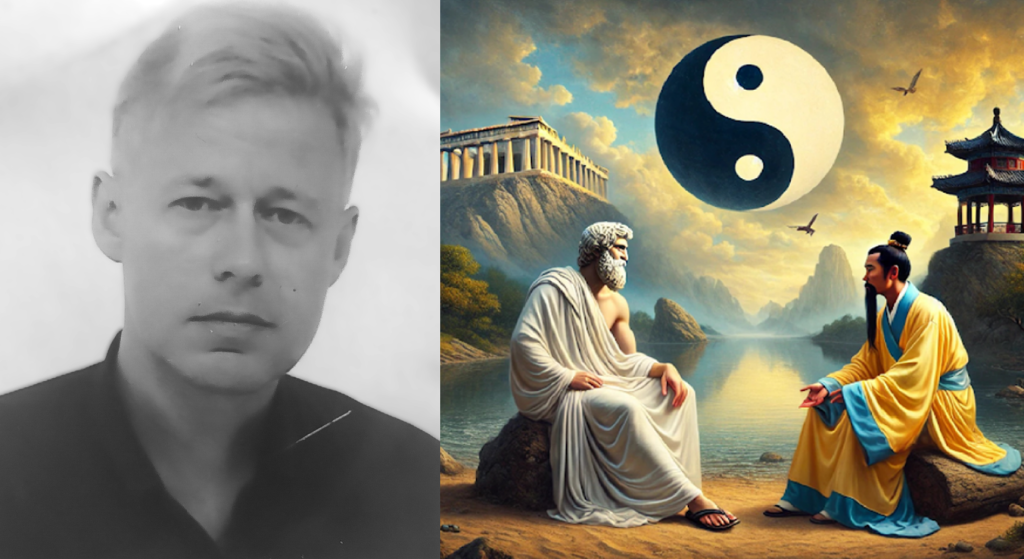
To understand how we arrived at this point, we must first go back to the origins. The philosophies of Heraclitus and Laozi, although separated by vast geographical and cultural distances, both grappled with the fundamental nature of reality and human existence. Yet their conclusions and the societies they influenced could not have been more different. Heraclitus emphasized the flux and conflict inherent in the universe, laying the groundwork for a Western worldview that prizes progress through struggle and competition. Laozi, by contrast, celebrated the harmony of opposites and the importance of aligning oneself with the natural flow of the Dao, shaping an Eastern ethos centered on balance and interconnectedness.
This divergence in philosophical outlooks was not merely theoretical; it was deeply rooted in the material conditions and economic structures of these societies. Ancient Greece, with its fragmented city-states and reliance on trade and colonization, fostered a culture of individualism and competition. Ancient China, with its centralized agrarian economy and emphasis on social hierarchy, cultivated a collective sense of order and responsibility.
These contrasting worldviews gave rise to divergent paths of development, not only in philosophy but also in governance, science, and the arts. Western philosophy, heavily influenced by the Greeks, evolved into a tradition that often seeks to master and control nature. This perspective reached its zenith during the Enlightenment, which celebrated human reason as the ultimate tool for understanding and shaping the world. The scientific revolution that followed brought unprecedented advancements but also entrenched a dualistic worldview that separated humanity from nature and mind from body.
Meanwhile, Eastern philosophy, drawing from Laozi, Confucius, and later Buddhist teachings, emphasized the interdependence of all things. It advocated for a holistic approach to understanding the world, one that recognizes the limits of human knowledge and the importance of humility. The emphasis on harmony and the cyclical nature of existence offered a counterpoint to the linear, progress-driven mentality of the West.
Yet, these differences were not absolute. Throughout history, there were moments of convergence and mutual influence. The Silk Road facilitated the exchange of goods, ideas, and cultural practices between East and West. Philosophers such as Leibniz and later Paul Mus and Iain McGilchrist recognized the potential for synthesis, advocating for a dialogue that could bridge these seemingly incompatible worldviews.
The challenges of our time demand such a dialogue. As humanity faces a global crisis of meaning, it becomes imperative to revisit the philosophical foundations that have shaped our world. This book seeks to uncover the roots of our current predicament and to propose a way forward—a path that draws upon the strengths of both traditions to build a more harmonious and sustainable future.
new concepts
List summarizing new concepts developed In this investigation
1. Ethossphere
2. Cultural Relativity (vs. Cultural Relativism)
3. Grounded Globalization
4. Conscious Cultural Evolution
5. Dynamic Integration
6. Integrative Economics
7. Transformative Integration
8. Practical Wisdom Integration
9. Developmental Coherence
10. Intercultural Resonance:
1. Ethossphere:
A layer of shared ethical consciousness that transcends while preserving cultural differences, analogous to but evolving beyond Teilhard's noosphere. Unlike mere moral universalism, it represents a field of dynamic ethical understanding that enhances rather than diminishes cultural distinctiveness while enabling genuine global integration.
2. Cultural Relativity:
Fundamental interconnectedness between different cultures and civilizations, mirroring relationship between space and time in physics. Distinct from and opposed to cultural relativism, it recognizes how cultures gain meaning and develop through relationship with each other, whether consciously acknowledged or not.
3. Grounded Globalization:
Integration that maintains connection with human and ecological realities rather than abstract financial metrics alone. Contrasts with current ultra-liberal globalization by emphasizing practical wisdom and actual human flourishing over mere profit maximization.
4. Conscious Cultural Evolution: "Conscious evolution of human civilization"
Process of cultural development that maintains awareness of interconnections while enabling transformation. Unlike blind evolution or forced homogenization, it represents intentional integration that preserves and enhances distinctive cultural contributions while facilitating higher synthesis.
5. Dynamic Integration:
Method of combining different approaches that maintains rather than eliminates creative tension between apparently opposing elements. Enables unity through rather than despite differences.
6. Integrative Economics:
Economic framework that combines Western analytical precision with Eastern holistic understanding, moving beyond both pure market capitalism and state control. Recognizes economic activity as embedded within broader patterns of human and ecological relationships while maintaining efficiency and innovation.
7. Transformative Integration:
Process by which different traditions or approaches enhance rather than merely combine with each other, generating higher forms of understanding and organization. Unlike superficial synthesis, it creates genuine transformation that preserves strengths while transcending limitations of original elements.
8. Practical Wisdom Integration:
Synthesis of different forms of knowledge that maintains balance between theoretical understanding and practical effectiveness. Combines Western emphasis on analytical precision with Eastern recognition of contextual wisdom and importance of practical engagement.
9. Developmental Coherence:
Quality of maintaining essential continuity while enabling transformation, demonstrated particularly in Chinese civilization's capacity for renewal. Unlike rigid preservation or chaotic change, represents ability to maintain cultural integrity through rather than despite development.
10. Intercultural Resonance:
State of meaningful relationship between different cultural traditions that enables mutual enrichment without loss of distinctive character. Contrasts with both isolation and homogenization by fostering what might be called "harmonic development."
The ethossphere provides an overarching field within which other concepts operate. It enables cultural relativity to manifest consciously rather than remaining implicit, while providing a framework for conscious cultural evolution to proceed. This relationship mirrors how space-time provides a field within which physical evolution occurs, but with crucial addition of conscious human participation in the developmental process.
Grounded globalization and integrative economics represent practical manifestations of these principles in the material sphere. They demonstrate how abstract understanding of cultural relativity translates into concrete organizational patterns. Dynamic integration provides methodology for this translation, while transformative integration describes the resulting process of development.
Practical wisdom integration and developmental coherence outline conditions necessary for successful cultural evolution. They explain how different traditions can maintain integrity while engaging in mutual enrichment. Cultural resonance then describes the quality of relationship that emerges when these conditions are met.
Together, these concepts suggest possibilities for what might be called "conscious evolution of human civilization" - development that maintains awareness of its own processes while enabling genuine progress. Unlike both traditional conservatism and radical progressivism, this framework recognizes how genuine advancement requires maintaining connection with accumulated wisdom while enabling transformation.
The interplay between these concepts reveals a deeper pattern of how cultural transformation might consciously proceed. Where ethossphere provides field and cultural relativity describes fundamental relationship between traditions, conscious cultural evolution represents an active process of development within this framework. This isn't merely theoretical structure but practical pathway for addressing contemporary challenges.
These relationships become particularly significant when considering the current global crisis. Ultra-liberal capitalism's reduction of everything to financial abstraction represents the exact opposite of grounded globalization, while postmodern relativism actively undermines the possibility of genuine cultural resonance. The concepts developed here don't just critique these problems but suggest concrete alternatives. Integrative economics demonstrates how efficiency and innovation can be maintained while reconnecting economic activity with actual human and ecological needs.
Dynamic and transformative integration become crucial methodological principles for implementing this understanding. They explain how apparently opposing elements - like Western analytical precision and Eastern holistic wisdom, or individual initiative and collective harmony - might enhance rather than merely compromise with each other. Practical wisdom integration then provides a bridge between theoretical understanding and actual implementation, while developmental coherence ensures cultural traditions maintain integrity through transformation.
This framework suggests possibility for what neither pure Western modernization nor rigid traditional preservation can achieve: conscious evolution of human civilization that enhances rather than diminishes cultural distinctiveness while enabling genuine progress. Unlike current globalization's tendency toward homogenization or reactionary emphasis on isolation, it offers pathways toward richer, more complex forms of human development.
These interlocking concepts ultimately provide a framework not just for understanding cultural development but for consciously participating in the evolution of human civilization. By recognizing fundamental relativity of cultural traditions while maintaining possibility of genuine integration, they suggest practical pathways toward development that enhances rather than diminishes human potential. This framework offers hope for addressing contemporary challenges through integration that preserves rather than eliminates distinctive contributions of different traditions.
EPILOG
Curricular Integration
The concepts developed throughout this investigation offer crucial resources for enriching educational curricula across multiple disciplines. In philosophical education, they provide a framework for moving beyond both Western universalism and postmodern relativism toward a more sophisticated understanding of cultural development and integration. For economics and political governance studies, they suggest practical approaches to combining efficiency with sustainability, individual initiative with collective harmony. Particularly significant is their potential contribution to the International Baccalaureate's Theory of Knowledge curriculum, where concepts like cultural relativity and conscious cultural evolution could help students develop a more nuanced understanding of how different forms of knowledge relate and develop. By introducing these ideas to young minds grappling with fundamental questions about knowledge and development, we plant seeds for more integrated approaches to addressing future challenges facing humanity.
For Theory of Knowledge courses, these concepts provide powerful tools for transcending traditional opposition between objectivism and relativism that often confuses students. Cultural relativity offers a sophisticated framework for understanding how different knowledge systems relate without falling into either dogmatic universalism or paralyzing relativism. The ethossphere concept helps students grasp how ethical understanding can develop across cultures while maintaining distinctive traditions, while conscious cultural evolution provides a framework for understanding how knowledge systems grow and interact.
In economics and political science curricula, integrative economics and grounded globalization offer crucial alternatives to current models that either absolutize market mechanisms or react against them with rigid state control. These concepts help students understand the possibility of economic organization that maintains efficiency while serving authentic human development. Dynamic integration demonstrates how apparently opposing principles - like market freedom and social responsibility - might enhance rather than merely limit each other.
Philosophy programs could particularly benefit from these frameworks when teaching comparative philosophy or global ethics. Rather than merely presenting different traditions side by side, concepts like transformative integration and cultural resonance suggest how genuine dialogue between traditions might proceed. Developmental coherence helps explain how traditions can maintain integrity while engaging with others, while practical wisdom integration bridges the gap between theoretical understanding and practical application that often troubles philosophical education.
At advanced secondary level, particularly in IB programs, these concepts could revolutionize interdisciplinary understanding. Theory of Knowledge's exploration of "Ways of Knowing" could be enriched by examining how cultural relativity affects perception, reason, emotion, and language. Students could analyze real-world cases where developmental coherence enabled civilizations to maintain identity while adapting to change, or study how lack of grounded globalization leads to current environmental and social crises. This framework provides tools for understanding complex global issues beyond simplified Western-centric or relativistic perspectives.
In undergraduate education, these concepts could bridge traditionally separated disciplines. Philosophy departments could integrate them into courses on epistemology and ethics, showing how cultural resonance enables genuine dialogue between traditions. Economics programs could use integrative economics to examine alternatives to pure market or state control systems. Political science courses could apply conscious cultural evolution to understanding international relations and development issues. Environmental studies could benefit from understanding how transformative integration might reconcile economic development with ecological preservation.
Graduate programs could develop these concepts further through specialized research. The ethossphere concept invites deeper investigation in fields ranging from cultural studies to global ethics. Practical wisdom integration suggests new approaches to professional education in fields like business, law, and public policy. These frameworks could guide research into pressing questions about sustainable development, cultural preservation in globalized world, and evolution of human consciousness in technological age.
The practical implementation of these concepts in educational settings requires careful attention to developmental stages and cultural contexts. At IB level, case studies prove particularly effective: analyzing how Chinese civilization maintained developmental coherence through multiple transformations; examining how Japanese Meiji restoration demonstrated conscious cultural evolution; or studying how current ultra-financial globalization contradicts principles of grounded globalization. Students could explore cultural relativity through comparative analysis of how different traditions approached similar challenges, while ethossphere concept helps them understand possibilities for genuine ethical dialogue across cultures.
For university programs, integration between disciplines becomes crucial. Business schools could combine study of integrative economics with practical training in cross-cultural negotiation and sustainable development. Environmental science programs could examine how transformative integration might reconcile technological advancement with ecological wisdom. International relations departments could apply these frameworks to understanding current global challenges:
- How cultural resonance might prevent conflict while preserving distinctiveness
- Why practical wisdom integration becomes crucial for addressing climate change
- How dynamic integration could guide technological development without losing human values
Research directions at graduate level suggest particularly rich possibilities:
- Investigating how ethossphere concept might guide development of artificial intelligence ethics
- Studying historical examples of successful cultural integration for insights into current challenges
- Developing new metrics for measuring success of grounded globalization versus pure financial indicators
ESSAY
The Epistemological Crisis in the West
Representations of Reality and Reality Itself
by Olivier LICHTENBERG
The
West is currently undergoing an unprecedented epistemological crisis.
Accustomed
for five centuries to being the world's producer of meaning, it now
confronts the emergence of civilizations thriving according to their
own logics, defying its conceptual categories and relativizing its
universalist pretensions. This crisis is not merely a geopolitical
adjustment; it reveals a structural incapacity to conceive difference
except as anomaly, threat, or imposture.
The
Chinese example crystallizes this impasse: how to comprehend a
modernity bypassing individualism, governmental efficiency not
resting on electoral democracy, a prosperity that does not replicate
the Western model? Faced with these questions, the West develops
sophisticated mechanisms of denial – from inverted Orientalism to
systematic moral disqualification – which reveal less the reality
of the Other than its own cognitive blind spots.
This
analysis proposes to explore the deep roots of this Western
habituation to denial, its contemporary manifestations, and the
possible paths toward a necessary epistemological revolution. For
what is at stake transcends the mere understanding of China: it
concerns the West's ability to remain a creative actor in a world
that no longer revolves around it.
Development
Habituation
to Denial and the Inversion of Reality
The
habituation to denial and the inversion of reality in France and the
West finds its roots in several profound historical and cultural
phenomena.
Historically,
France developed a particular relationship with ideology and "grand
narratives" since the French Revolution. This Jacobin tradition
often privileges theoretical coherence over empirical reality,
creating a political culture where ideas can override facts. The
revolutionary legacy instilled distrust towards the "evidences"
of the old world and a belief in the capacity of political will to
transform reality.
The
influence of Marxism and revolutionary ideologies in the 20th century
reinforced this tendency. The idea that apparent reality masks hidden
power relations fostered a generalized hermeneutics of suspicion.
This interpretive lens can lead to rejecting inconvenient facts as
manifestations of "false consciousness" or manipulation.
The
French educational system, centered on essay writing and abstract
argumentation rather than empiricism, also contributes to this
culture. The valorization of elegant logical demonstration can
overshadow pragmatic observation of phenomena.
French
exceptionalism, expressed in the conviction of embodying universal
values, can also generate resistance to acknowledging realities
contradicting this self-proclaimed civilizing mission.
These
psychological and cultural mechanisms explain why certain discourses
persist in France despite their disconnect from observable facts,
creating a "habituation" to denial.
The
Importance of the Contemporary Context
The
habituation to denial takes particularly marked forms today in the
perception of the foreign and ongoing civilizational transformations.
Denial
of Relative Decline
France
struggles to accept its real geopolitical position in a multipolar
world. The illusion of "eternal France" and its universal
radiance collides with the reality of declining influence. This
cognitive dissonance generates a collective denial manifested in a
systematic overestimation of French "soft power" and an
underestimation of real global dynamics.
The
Biased Perception of China
The
Chinese example is particularly revealing. France oscillates between
two symmetrical denials: on one hand, the demonization of a system
presented as necessarily fragile and doomed to collapse; on the
other, blindness to the realities of Chinese governmental efficiency.
This double blindness prevents a lucid analysis of ongoing
geopolitical transformations.
French
media tend to present China through the distorting prism of a
Western-centric interpretive grid, obscuring this civilization's
inherent logics and its adaptive capacity. The inability to
understand the Chinese "longue durée" and its
multi-secular strategies reflects this French difficulty in escaping
its own frames of reference.
The
Ideological Inversion of Power Relations
French
discourse continues to present the West as "besieged" by
authoritarian forces, while geopolitical reality shows rather a
global rebalancing where Europe becomes peripheral. This inversion
allows maintaining a comfortable moral posture while avoiding
questioning the foundations of our model.
Internal
Civilizational Problems
Denial
also concerns internal transformations: territorial fragmentation,
communitarianism, crisis of authority, crumbling of republican
institutions. These phenomena are either denied or euphemized by
reassuring concepts ("diversity," "living together")
masking the scale of the challenges.
The
inability to name certain migratory, security, or cultural realities
stems from this same logic
of inversion,
where empirical observations are disqualified in favor of ideological
constructions. The "real" becomes suspect; only conformity
to the normative
discourse
counts.
The
Manufacture of Contemporary Denial
This
habituation is amplified today by several factors: the information
bubble of elites, disconnected from popular realities; the
hyper-moralization of public debate prohibiting certain topics; and
paradoxically, the influence of an intellectual Americanism (wokeism,
cancel culture) presented as non-conformist but imposing new taboos.
The
result is a country telling itself stories about itself and the
world, cultivating a growing gap between its representations and the
real dynamics at work in 21st-century globalization.
Western
resentment,
and particularly French resentment, linked to the failure of Asian
colonization, constitutes indeed a major key to understanding these
contemporary denials.
Repressed
Historical Humiliation
Unlike
Africa, where colonization could impose itself durably, Asia
represented a crushing failure for Western imperial ambitions. France
certainly dominated Indochina, but this domination met constant
resistance and ended with the humiliating defeat at Diên Biên Phu
in 1954. More broadly, the West never truly succeeded in "civilizing"
China, despite the Opium Wars and the dismemberment of the 19th
century.
This
inability to durably subjugate millennial civilizations generated a
profound resentment, in the Nietzschean sense: an
unavowed rancor towards those societies that resisted Westernization
and are today reclaiming their central place in world history.
Compensatory
Inversion
This
resentment translates into systematic inversion: since Asia resists
our "values," it must necessarily be deficient. Hence the
recurrence of prophecies about Chinese collapse, the "unsustainable"
dictatorship, the lack of Asian "creativity," etc. These
analyses reveal less Chinese reality than the Western need to
reassure itself of its supposed superiority.
France,
in particular, struggles to accept that its civilizing mission failed
in the face of societies modernizing according to their own logics,
without adopting the Western model. China's emergence as a major
technological and economic power reactivates this repressed colonial
trauma.
The
Revenge of the "Failed Colonized"
The
current Asian rise appears as the historical revenge of civilizations
the West never managed to fully subdue. This revenge is all the more
bitter as it often operates with the very tools of Western modernity
(technology, capitalism, state organization) but diverted to serve
non-Western civilizational projects.
The
Asian economic "miracle," from South Korea to Vietnam via
China, demonstrates that development can follow paths other than
those theorized by the West. This reality shakes the Western
narrative of the universality of its model and the necessity of its
"values" for prosperity.
Denial
as a Defense Mechanism
Faced
with this challenge, denial becomes a psychological and cultural
defense mechanism. It is more comfortable to deny Chinese success
(talking of a "bubble," "fragile dictatorship,"
etc.) than to recognize the efficiency of a system defying Western
postulates about democracy, human rights, and social organization.
This attitude reveals an inability to conceive the plurality of
developmental paths and an identity-based rigidity in the face of the
relativization of Western exceptionalism. Colonial resentment
transforms geopolitical analysis into historical score-settling,
preventing any lucid understanding of contemporary global dynamics.
Inverted
Orientalism
Edward
Said analyzed Orientalism as a tool of colonial domination. Today, we
observe an "inverted Orientalism": since the Orient resists
and prospers, it must be morally disqualified to preserve Western
superiority. This logic perpetuates denial by transforming every
Asian success into a temporary anomaly or an imposture to be
unmasked.
Inverted
Orientalism: From
Domination to Disqualification
Classical
Orientalism, as analyzed by Edward Said, served to justify colonial
domination by presenting the Orient as immature, irrational, despotic
yet fascinating. This representation legitimized "civilizing"
Western intervention. Contemporary inverted Orientalism proceeds
differently: it now involves morally disqualifying Eastern success to
preserve Western symbolic hegemony.
The
Mechanics of Inversion
Where
colonial Orientalism depicted Asia as stagnant and incapable of
progress, inverted Orientalism recognizes Asian dynamism but empties
it of all legitimacy. China is no longer presented as backward, but
as "artificial," "unsustainable," "inhumane."
This inversion maintains the Western hierarchy while accounting for
geopolitical reality.
The
old Orientalism said: "They are weak, therefore we must dominate
them." The new says: "They are strong, but wrongly so,
therefore we remain morally superior." This intellectual
gymnastics reconciles empirical evidence (China's rise) with the
psychological necessity of maintaining Western superiority.
The
New Disqualifying Stereotypes
Inverted
Orientalism produces a new set of stereotypes:
-
Asian innovation becomes "copying" or "technological
theft"
-
Governmental efficiency becomes "totalitarian oppression"
-
Social stability becomes "conformism" or "brainwashing"
-
Long-term planning becomes "bureaucratic rigidity"
-
Patriotism becomes "aggressive nationalism"
Each
Asian strength is thus turned into a moral weakness, preserving the
image of a West admittedly weakened, but remaining the standard of
civilization.
Temporal
Inversion
Colonial
Orientalism projected the Orient into the past ("they still live
in the Middle Ages"). Inverted Orientalism projects it into a
dystopian future ("they anticipate our totalitarian nightmare").
This temporal inversion maintains the West as the normal reference,
with Asia becoming either archaic or monstrously modern.
This
logic explains why Chinese technological successes (5G, artificial
intelligence, smart cities) are systematically presented through the
lens of surveillance and control, rather than as potentially
beneficial innovations.
Disqualification
by Exception
Inverted
Orientalism also proceeds by "exceptionalization": Asian
successes are presented as historical anomalies, geopolitical
accidents, or speculative bubbles. This logic refuses to see them as
a viable alternative model, thereby preserving the supposed
universality of the Western model.
China
thus becomes a "state capitalism" (a revealing oxymoron), a
"market authoritarianism" (another contradiction in terms),
artificially maintaining the belief that only liberal democracy can
generate prosperity and innovation.
Victimhood
Inversion
Particularly
perverse, this dimension presents the West as the victim of Asian
success. The "Belt and Road" becomes a "debt trap,"
Chinese investments in Africa become "neocolonialism,"
Asian competitiveness becomes "unfair competition." This
victimhood inversion allows maintaining the moral posture while
refusing to assume responsibility for the West's relative decline.
The
Psychological Function of Inversion
This
inversion responds to a deep psychological need: preserving Western
collective self-esteem in the face of the evidence of multipolarity.
It reconciles the factual recognition of Asia's rise with the
maintenance of Western symbolic superiority.
Inverted
Orientalism thus constitutes a sophisticated form of denial: it no
longer denies facts, but their meaning. It transforms every Eastern
success into a moral anomaly, every innovation into perversion, every
stability into oppression. This intellectual alchemy maintains the
illusion of Western centrality in a world that relativizes it more
each day.
The
Cognitive Impasse
This
inversion generates a major cognitive impasse: incapable of
understanding the inherent logics of Asian societies, the West
condemns itself to undergo transformations it refuses to analyze
lucidly. Inverted Orientalism thus becomes an obstacle to any
strategy adapted to the geopolitical realities of the 21st century.
The
Epistemological Impasse: When
Method Becomes Obstacle
The
cognitive impasse generated by inverted Orientalism reveals a deeper
epistemological crisis in the West. It is no longer just about
perceptual biases, but a structural inability to produce valid
knowledge about the non-Western world.
Imprisonment
in Western Categories
The
Gödelian Impasse: When
Logic Reveals Its Own Limits
Kurt
Gödel's incompleteness theorems (1931) reveal a fundamental flaw in
the Western ambition of total systematization of reality. By
demonstrating that no consistent axiomatic system can be both
complete and prove its own consistency, Gödel dealt a fatal blow to
the Cartesian dream of a universal method of knowledge. This
mathematical discovery resonates particularly with the Western
inability to grasp China: any conceptual system sufficiently powerful
to describe complex realities necessarily generates undecidable
propositions, shadow zones that its own axioms cannot illuminate. The
Western insistence on "solving" the Chinese "contradiction"
(effective authoritarianism, non-Western modernity) reveals precisely
this illusion of completeness that Gödel mathematically refuted.
Einstein
and Gödel
The
Gödelian Critique of the Western Axiomatic Foundation
More
profoundly, Gödel's work highlights the arbitrariness of the
axiomatic foundations underpinning modern Western epistemology. The
fundamental postulates of Western modernity – methodological
individualism, subject/object separation, primacy of instrumental
reason – cannot demonstrate their own validity without logical
circularity. This impossibility of self-foundation reveals that any
system of thought ultimately rests on cultural and historical choices
rather than universal evidences. Faced with China, which operates
according to different axioms (primacy of the collective, correlative
thinking, dynamic harmony), the West confronts Gödelian
undecidability: it is impossible to demonstrate the superiority of
its own postulates without presupposing them. This logical impasse
explains why the debate on "values" systematically turns
into a petition of principle, each system only being able to
legitimize its axioms from within its own categories.
Modern
Western epistemology was built on fundamental dichotomies
(individual/collective, freedom/authority, private/public,
secular/religious) that structure its understanding of the world.
These historically situated categories have become supposed
universals, obligatory grids for analyzing any reality.
Faced
with China, this grid produces revealing oxymorons: "state
capitalism," "effective authoritarianism," "Confucian
modernity." These contradictions in terms signal less Chinese
incoherence than the inadequacy of Western categories for grasping
realities organized according to different logics.
The
Vicious Circle of Validation
The
epistemological impasse is reinforced by a circular mechanism:
Western academic, media, and political institutions mutually validate
their biased analyses. An "expert" trained in Western
universities, publishing in Western journals, cited by Western media,
produces "knowledge" that confirms Western prejudices.
This
incestuous intellectual endogamy generates factitious "consensus"
masking incomprehension. The rare dissenting voices are marginalized
as "complacent" towards "dictatorships," creating
an environment where epistemological critique becomes impossible.
The
Illusion of Methodological Neutrality
The
modern West developed the illusion that its methods of knowledge
(empiricism, critical rationality, methodological individualism) are
universally neutral. This claim to objectivity masks in reality
epistemological ethnocentrism: what is presented as "science"
is often merely the projection of Western cultural presuppositions.
This
illusion prevents recognizing that other civilizations may have
developed different but equally valid modes of knowledge. Chinese
thought, for example, privileges processual logic over substantive
logic, correlation over causality, dynamic harmony over dialectical
opposition.
The
Reification of Concepts
The
epistemological impasse manifests itself in the reification of
historically situated concepts. "Democracy," "human
rights," "rule of law" become transhistorical essences
rather than particular social constructions. This reification
prohibits conceiving other forms of political legitimacy or social
organization.
When
China develops its own concepts ("whole-process people's
democracy," "socialist rule of law"), they are
automatically disqualified as "propaganda" rather than
recognized as legitimate attempts at alternative conceptualization.
The
Inability to Think Difference
Contemporary
Western epistemology oscillates between two symmetrical impasses:
abstract universalism (all humans are identical) and cultural
relativism (each culture is incommensurable). Both positions prevent
thinking difference as a cognitive resource.
Universalism
projects Western categories onto all societies. Relativism renounces
all understanding. Neither allows apprehending the specificity of
non-Western civilizational logics as sources for rethinking our own
categories.
The
Pathology of Overinterpretation
Faced
with incomprehension, the West develops a pathology of
overinterpretation. Every Chinese gesture is analyzed as a "signal,"
every policy as a "hidden strategy." This generalized
hermeneutics of suspicion reveals the inability to take seriously the
discourses and inherent logics of other civilizations.
This
paranoid overinterpretation (Chinese "hegemonic ambitions,"
"secret plans" for world domination) often masks the
projection of Western logics onto the Other. The West, accustomed to
imperialism, can only conceive Chinese emergence as competing
imperialism.
The
Epistemological Obstacle of Temporality
The
modern West privileges linear, progressive time, oriented toward the
future. This temporality structures its understanding of social and
political change. Faced with China, which thinks in long cycles and
millennial continuities, this temporal grid produces systematic
misinterpretations.
Chinese
"reforms" are interpreted as progressive "liberalization"
towards the Western model, whereas they are inscribed in a
specifically Chinese logic of modernization. This temporal
misunderstanding generates constantly disproven prophecies (the
"inevitable democratization" of China).
The
Impasse of Measurement
Western
epistemology privileges quantification, measurement, indicators. This
approach, relevant in its domain, becomes an obstacle when it claims
to grasp qualitative realities. How to "measure"
governmental legitimacy, popular satisfaction, social cohesion?
Western indices (press freedom, corruption, competitiveness) capture
only part of reality.
This
obsession with measurement generates paradoxes: China "fails"
according to Western criteria while "succeeding" according
to empirical criteria of development, stability, popular
satisfaction. This contradiction reveals the inadequacy of the
measuring instruments rather than Chinese incoherence.
Toward
a General Epistemological Crisis
This
impasse concerns not only the understanding of China but reveals a
general epistemological crisis of the West. Accustomed to being the
center of the world, producer of universal concepts, the West
confronts its own provincialization.
This
epistemological crisis is all the more painful as it coincides with
the challenge to Western hegemony. The inability to understand the
Other becomes an inability to understand oneself, generating a spiral
of denial and resentment preventing any adaptation to new
geopolitical realities.
Emerging
from this impasse would require an epistemological revolution:
accepting that the West is but one civilization among others, with
its own historically situated categories, and developing genuine
intellectual curiosity for other modes of thought and social
organization.
Conclusion:
The West Before the Shattered Mirror of its Certainties
This
analysis reveals that the French and Western habituation to denial is
not mere circumstantial myopia, but a system of deep cognitive
interferences compromising the ability to lucidly apprehend the
transformations of the contemporary world.
The
Hemiplegic Interpretive Grid
The
West suffers from a true intellectual hemiplegia: half its cognitive
apparatus remains paralyzed by the inability to think outside its own
categories. This epistemological infirmity transforms every
analytical attempt into ethnocentric projection. Faced with China,
the West sees only what its conceptual grids allow it to see,
condemning to incomprehension everything escaping its founding
dichotomies.
This
hemiplegia generates systematic blind spots: non-democratic
governmental efficiency becomes invisible, legitimacy without
elections unthinkable, modernity without individualism inconceivable.
The West analyzes the world with a brain of severed connections,
incapable of integrating data contradicting its pre-established
schemas.
Defensive
Psychological Projections
Behind
the apparent rationalism of Western analyses hide defensive
psychological mechanisms of rare violence. Western chauvinistic
narcissism, wounded by the relativization of its historical
centrality, projects its own logics onto the Other to disqualify it.
Yesterday's Western imperialism becomes today's Chinese imperialism,
past Western domination justifies the demonization of present Asian
emergence.
These
projections reveal a pathological inability to recognize the Other as
different and legitimate. The West can only conceive Chinese success
as a temporary anomaly, moral imposture, or existential threat. This
projective logic transforms every geopolitical analysis into an
identity psychodrama.
Jung's
archetype of the Shadow illuminates the West's persistent denial in
the face of interconnectedness. What the left hemisphere represses –
context, relation, embodied reality – becomes a threatening shadow,
projected onto Eastern thought and then rejected. This dynamic
explains the Western tendency to simultaneously romanticize and
reject Eastern wisdom traditions. Puccini's opera Turandot is but one
of many examples perfectly illustrating the Orientalist prejudices of
its time. The fear motivating this rejection echoes Jung's
observation that what we fear most often contains what we most need
for psychological integrity.
After
an initially favorable takeoff of globalized trade, tensions begin to
emerge. These tensions reflect the typical resistance to archetypal
transformation, what Jung called "resistance to consciousness."
Trade wars and hostile discourses, particularly from the West,
represent the fear of ego dissolution facing its Shadow. While trade
has brought us physically closer, it has activated deeper archetypal
fears that could widen the psychological gap. Mind the gap!
Literal
interpretation, however, produces dogmatic doctrines that divide
humanity. History bears witness: the Crusades, European religious
wars, ongoing conflicts in the Middle East: all stem from literal
interpretations manipulated for political ends. Power elites
manipulate religious doctrine to dominate and exploit the masses,
reinforcing their economic and political control. In today's
ultra-liberal postmodern economy, these elites have effectively
divorced themselves from their own people. The masses, gripped by
fear, become prey to fanatical religious or nationalist ideologies,
rarely recognizing the manipulation at work.
True
spirituality should reconnect, exactly what the Latin root of
religion, re-ligare, means: to bind together. This aligns perfectly
with Teilhard de Chardin's concept of increasing complexity and
consciousness, Bloch's vision of hope, and Mus's planetary
philosophy. For Bloch, this reconnection would transcend traditional
dichotomies: idealism versus materialism, capitalism versus
socialism. These opposites could unite in a higher synthesis, a
central theme of this work. Modern quantum mechanics confirms this
vision: entanglement (intrication) is not limited to particles; it
characterizes reality itself. Everything is interconnected. It is
worth mentioning the influence of Jung's very close friend Wolfgang
Pauli, who drew parallels between his quantum concept of entanglement
and Jung's psychoanalytic concept of synchronicity.
Particularly
relevant is Krishnamurti's insistence that psychological division is
the root of social conflict. He saw that the fragmentation of
consciousness, which this essay identifies as specifically Western
but now having acquired global influence, inevitably leads to
conflict, both internal and external. His statement "The
observer is the observed"
directly challenges the Parmenidean division between subject and
object that we identified as the root of Western schizophrenia in the
modernist and postmodernist era.
Krishnamurti's
insights on fear and conditioning speak directly to our analysis of
how Western consciousness perpetuates its own fragmentation. He saw
that fear, which we identified as a key factor in left-hemisphere
dominance, was not merely a personal emotion but a collective
condition maintained by social and educational systems. His critique
of both organized religion and secular materialism reveals the same
pattern of rigid and literal thinking that Bloch identified in his
analysis of religious interpretation.
The
metaphor of the "seed and the sower" in
Laurens
Van der Post's
work of the same name reveals how gaps themselves, like the space
between seed and soil, are necessary for new growth. Just as Western
schizophrenia created spaces between subject and object, mind and
body, self and other, these spaces can become fertile ground for new
integration when approached with awareness rather than fear. “Mind
the gap!” becomes not a warning of danger but an invitation to
transformation.
Van
der Post's narrative, emerging from the most extreme manifestation of
East-West division in a prisoner-of-war camp, demonstrates how even
the widest gaps contain potential for connection. Like the gap
between brain hemispheres described by McGilchrist, like the gap
between literal and metaphorical understanding analyzed by Bloch,
these spaces of apparent division can become places of creative
possibility. As we face contemporary global crises born of divided
consciousness, this story reminds us that transformation often begins
precisely where division seems most absolute.
Fear
often underpins cultural misunderstanding. When a culture feels
threatened by another, defensive reactions can prevent authentic
dialogue. Creating safe spaces for cultural expression becomes
crucial.
Fear
plays a more insidious role in this hemispheric shift than previously
recognized. The cynical use of fear as an instrument of power by
leaders ensures their perpetual grip on the masses. This manifests in
multiple layers: When people fear appearing fearful, they often deny
and repress their emotions, leading to neurosis. Methods range from
subtle intimidation to pure terror, all justified by the desire to
maintain authority. But the mechanism acts more deeply - peer
pressure exacerbates this effect, creating fear of ostracism and
isolation. This pushes toward conformity and opportunism while
fostering a guilty conscience requiring painful self-repression,
resulting ultimately in nervous exhaustion, neurosis, and in extreme
cases, dementia. Dissociation from the self, as in Stockholm
syndrome, leads to paranoid schizophrenia.
McGilchrist's
analysis becomes particularly relevant here. He explains that the
left hemisphere produces an explicit and analytical map of our
thought, a re-presentation of reality. In schizophrenia, this
abstract formal map substitutes itself for reality itself, which
normally presents itself implicitly to the right hemisphere. The mind
becomes trapped in a delusional formal logic, capable of denying the
existence of anything outside its own constructions. What presents
itself implicitly to the right hemisphere becomes denied when
convenient by abstract formal logic which can deny the real existence
of the reality of anything outside ourselves.
The
contrast with Chinese thought is illuminating. China's practical
reasoning and absence of dualistic Platonism, along with its
balancing of opposites instead of a logic based on irrational
postulates and undemonstrable axioms (Kurt Gödel), seem to have
helped it avoid these pitfalls of massive shifts from right-brain to
left-brain dominance. This balance manifests not only in philosophy
but in practical governance, medicine, and social organization.
Paul
Mus's vision of a planetary philosophy deserves closer examination
here. As a French scholar who deeply understood Vietnam, Mus
attempted to bridge the philosophical gap between East and West
despite the bitter weight of colonial history. His work at the École
française d'Extrême-Orient and later at Yale University
demonstrated how cultural understanding could transcend political
conflicts.
The
fate of the German Jewish minister
Walther
Rathenau,
assassinated by the proto-Nazis who feared precisely the type of
integration he represented, serves as a stark reminder of what is at
stake in our current efforts toward cultural and economic
integration. The forces of fragmentation and reaction he confronted
persist in different forms today, making his insights on combining
economic efficiency with social responsibility, and technological
advancement with human values, particularly relevant to our
contemporary challenges.
The
role of fear in social control deserves particular attention. Western
societies have developed sophisticated fear-based manipulation
mechanisms, from media sensationalism to consumption anxiety.
Countering them requires:
-
Developing community structures resilient to fear.
-
Creating alternative economic models reducing precarity.
-
Restoring meaningful social bonds.
-
Integrating courage-building practices from diverse cultural
traditions.
Masked
Existential Angst
At
the heart of these denials lies a deep existential angst: that of no
longer being the center of the world, of seeing its "universal
values" relativized, its certainties shaken. This angst,
unavowable because contrary to the Western self-image, generates
denial strategies all the more sophisticated for being unconscious.
Inverted
Orientalism, paranoid overinterpretation, systematic moral
disqualification constitute so many defense mechanisms against this
angst of decentering. The more the evidence of multipolarity imposes
itself, the more these mechanisms radicalize, creating a vicious
circle where incomprehension feeds angst which feeds incomprehension.
The
Impasse of Reflexivity
This
situation generates a tragic impasse: the West becomes incapable of
the critical reflexivity that constitutes one of its most precious
contributions to humanity. Prisoner of its own projections, it can no
longer apply to itself the analytical tools it developed to
understand the world.
This
loss of reflexivity compromises any capacity for adaptation to new
geopolitical realities. How to devise a relevant strategy toward
China when refusing to understand its inherent logics? How to
cooperate with civilizations disqualified a priori? How to maintain
influence in a world one refuses to see as it is?
The
Urgency of a Cognitive Revolution
Emerging
from this impasse requires a true cognitive revolution: accepting the
end of Western exceptionalism, recognizing the legitimacy of other
developmental paths, developing genuine intellectual curiosity for
other modes of thought. This revolution involves abandoning
chauvinistic narcissism in favor of rediscovered intellectual
humility.
This
transformation is necessary not only to understand the Other but to
understand oneself. By refusing to see China as it is, the West
deprives itself of the possibility to rethink its own categories,
renew its approaches, and rediscover a creative dynamic. The denial
of the Other becomes denial of self; the incomprehension of the world
becomes incomprehension of one's own situation.
The
stakes are no longer merely geopolitical but civilizational: will the
West overcome its cognitive interferences to rediscover that capacity
for learning and adaptation which was historically its strength? Or
will it remain prisoner of its own projections, condemned to undergo
transformations it stubbornly refuses to understand? The answer to
this question will largely determine its capacity to remain a
relevant actor in the 21st-century world.
The
Legacy of Hans Fürstenberg
Hans
Fürstenberg, a German Jewish financier and bibliophile who acquired
the Château de Beaumesnil in 1938 and died in 1982, bequeathing the
château to a foundation charged with preserving his property and
library, was an unjustly overlooked visionary.
Fürstenberg's
profile is intriguing in this context. A German Jewish intellectual,
refugee from Nazism, bibliophile and likely privileged observer of
European transformations, writing in the 70s a "dialectic for
the 21st century," indeed presents the profile of a potentially
visionary thinker.
His
position as an exile likely afforded him the critical distance
necessary to analyze the impasses of Western thought we have
discussed. His experience of uprooting and civilizational
confrontation could have sensitized him to the mechanisms of
projection and blindness we have analyzed.
Did
he anticipate the Western epistemological impasses facing Asian
emergence? Was he developing a critique of Orientalism even before
Edward Said?
His
reference to Heraclitus in "Dialektik für das 20. Jahrhundert"
is particularly illuminating and lends a prophetic dimension to
Fürstenberg's thought in light of our discussion.
Heraclitus
and the Anticipation of Western Impasses
The
return to Heraclitus in the 70s reveals a remarkable intuition. Where
dominant Western thought privileged binary logics (East/West,
freedom/authoritarianism, progress/tradition), Fürstenberg seems to
have sensed the necessity of a more fluid, more processual,
dialectic, more in line with the realities of historical becoming.
Heraclitean
thought, with its conception of the logos as harmony of opposites and
perpetual flux ("one cannot step into the same river twice"),
offered indeed an alternative to the Western conceptual rigidities we
have analyzed. This approach would have allowed apprehending China's
rise not as anomaly or threat, but as a natural manifestation of
world dynamics.
Processual
Dialectic versus Orientalism
If
Fürstenberg was developing a Heraclitean dialectic, he likely
anticipated the critique of Orientalism before Said. The Heraclitean
approach indeed prohibits the reification of cultural identities:
civilizations are not fixed essences but dynamic processes in
perpetual transformation.
This
vision would have allowed understanding contemporary China as a
creative synthesis between millennial tradition and technological
modernity rather than as an insurmountable contradiction between
"Asian values" and "Western progress." The error
of the inverted Orientalism we described results precisely from this
inability to think dialectical becoming.
The
Prescience of the 21st Century
The
shift from a "dialectic for the 20th century" to a
"dialectic for the 21st century" suggests Fürstenberg
anticipated a major historical mutation. The 20th century, dominated
by binary ideological confrontations (fascism/democracy,
capitalism/communism), called for a dialectic of confrontation. The
21st century, marked by multipolarity and the interpenetration of
civilizations, would demand a
dialectic of complementarity.
This
intuition proves prophetic in light of contemporary impasses. The
Western inability to think coexistence with alternative systems
(China, Russia, the Islamic world) reveals the inadequacy of
20th-century categories to 21st-century realities.
The
Implicit Critique of Western Narcissism
A
Heraclitean dialectic implies intellectual humility: recognizing that
every position is relative, every truth partial, every civilization
transitory. This approach would have safeguarded against the Western
chauvinistic narcissism we have analyzed.
Fürstenberg,
as an uprooted Jewish intellectual, likely possessed this lucidity
regarding the relativity of civilizational certainties. His
experience of exile afforded him that critical distance necessary to
perceive the blind spots of Western thought.
The
Anticipation of the Epistemological Impasse
If
Fürstenberg was developing a critique of Western categories in the
70s, he anticipated the contemporary epistemological impasse.
Heraclitean thought, with its logic of becoming and interpenetration
of opposites, offered an alternative to the paralyzing dichotomies of
Western modernity. This approach would have allowed understanding
"Chinese modernity" not as an oxymoron but as creative
synthesis, "effective authoritarian governance" not as
contradiction but as a particular modality of social organization.
The
Visionary Relevance
Fürstenberg's
visionary relevance would thus lie in this triple anticipation:
His
recourse to Heraclitus reveals a profound intuition: only a thought
of flux and transformation can grasp the mutations of the
contemporary world. The West, prisoner of its fixed essences and
binary categories, has condemned itself to incomprehension.
This
vision, if confirmed by the in-depth study of his works, would make
Fürstenberg an unrecognized precursor of the contemporary impasses
of Western thought facing Asian emergence. Only today does the
relevance of his overlooked work become evident. His last major work
"Dialektik des XXIten Jahrhunderts: ein Diskurs; der neue Weg
des Denkens von der Atomphysik bis zu den Wissenschaften vom
Menschen" (Dialectic for the 21st Century: A Discourse; The New
Way of Thinking from Atomic Physics to the Sciences of Man) is all
the more significant as it was written in the 70s and even contains
an explanation for the reasons for its foreseen, deliberate and
unfortunate occultation.
Heraclitean
Dialectic as Antidote to Western Rigidity
If
Fürstenberg was developing a Heraclitean dialectic specifically for
the 21st century, he likely diagnosed the very problem we have
identified: the Western tendency toward rigid binary thinking
creating epistemological blind spots. Heraclitean thought, with its
emphasis on flux, process, and the unity of opposites, would have
offered a profound alternative to the categorical thinking
underpinning Western Orientalism.
Anticipating
the Epistemological Crisis
Writing
this work in the 1970s, Fürstenberg witnessed the early signs of the
Western intellectual sclerosis we have analyzed. The Heraclitean
approach – where truth emerges through the tension of opposites
rather than their exclusion – directly contradicts the Western
tendency to resolve contradictions by eliminating one side. This is
precisely the mechanism behind "inverted Orientalism" where
Eastern success must be morally disqualified to preserve Western
superiority.
The
Prophetic Dimension
The
visionary quality of Fürstenberg's work lies in recognizing that the
20th century's ideological conflicts (fascism vs. democracy,
capitalism vs. communism) were symptoms of a deeper epistemological
problem: the Western inability to think difference dialectically. His
Heraclitean framework would have anticipated how this same rigidity
would later manifest in the inability to understand Chinese success
or Islamic resilience.
Hans
Fürstenberg
The
Tragic Irony
The
tragic irony is that Fürstenberg, writing from his position as a
Jewish exile who lived through the collapse of European certainties,
was developing precisely the intellectual tools that could have
prevented the contemporary Western impasse. His work represents a
path not taken – a path toward epistemological humility that could
have allowed for an authentic understanding of civilizational
difference.
This
makes his relative occultation all the more significant in relation
to our discussion on Western denial mechanisms.
General
Conclusion:
Toward
a Western Epistemological Renaissance
The
Challenges of the Multipolar Transition
The
analysis of the Western epistemological crisis reveals the magnitude
of the challenge to be met. The transition toward a multipolar world
constitutes not only a geopolitical readjustment but demands a
complete refoundation of Western modes of thought. This mutation
requires abandoning five centuries of intellectual habits: the
pretension to the universality of its categories, the illusion of the
neutrality of its methods, the conviction of its civilizational
exceptionalism.
The
main challenge lies in the necessary epistemological humility. The
West must learn to think its own historical particularity, recognize
the relative arbitrariness of its axiomatic foundations, accept that
other civilizations can develop legitimate and effective paths of
modernization. This cognitive revolution implies overcoming the
chauvinistic narcissism that transforms every challenge into an
identity wound.
The
Opportunities of Decentering
Paradoxically,
this forced decentering could open unprecedented perspectives for
intellectual renewal. Confrontation with Chinese otherness, far from
being only a threat, constitutes an exceptional opportunity for
conceptual enrichment. Western thought could rediscover a creative
dynamic by integrating other modes of reasoning: Chinese processual
logic, correlative thinking, systemic long-term approaches.
This
cross-fertilization would allow overcoming the impasses of late
Western modernity: atomized individualism, short-termism,
disciplinary fragmentation, the sterile opposition between tradition
and modernity. The Chinese example of creative synthesis between
millennial heritage and technological innovation offers fruitful
avenues for rethinking the articulation between continuity and
change.
Toward
an Epistemology of Complementarity
Hartmut
Rosa's concept of resonance offers particularly relevant perspectives
for contemporary challenges. His critique of "dynamic
stabilization" helps explain why increasing technological
capabilities and economic growth fail to fulfill promises of human
flourishing. The alternative he proposes – developing
a meaningful relationship with the world rather
than seeking to control it – aligns remarkably with Eastern
philosophical intuitions concerning harmony and balance.
This
means we are inside the observed world as mystical parts of it,
rather than observing it from an illusory vantage point outside it.
We observe ourselves, the observer, while we observe the world, and
particularly HOW we observe it, much like in a "mise en abyme."
Any other epistemological paradigm, like the modernist, dualist
separation of subject and object, observer and observed field,
becomes obsolete.
The
necessary epistemological revolution could draw inspiration from the
Heraclitean dialectic anticipated by visionary thinkers like Hans
Fürstenberg. This approach would substitute a ternary logic of
complementarity for the binary logic of exclusion. Apparent
"contradictions" (effective authoritarianism, non-Western
modernity, non-democratic development) would become creative tensions
revealing the complexity of the real.
This
renewed epistemology would allow conceiving a world where multiple
developmental paths coexist and mutually enrich each other, where
civilizational diversity becomes a resource rather than an obstacle,
where geopolitical competition does not exclude intellectual
cooperation.
The
revolutionary work of Fritjof Capra reveals how modern quantum
physics has unintentionally validated ancient Eastern wisdom about
the fundamentally interconnected nature of reality. His crucial
insight that "physics and metaphysics both lead to the same
knowledge" points toward a revolutionary epistemological shift
that could transform our way of understanding and interacting with
reality itself.
Capra's
contribution lies in his demonstration that consciousness and context
are not peripheral concerns but fundamental aspects of any authentic
representation of reality. His critique of Cartesian dualism and
mechanistic reductionism exposes a critical flaw in Western
epistemology: its tendency to fragment reality into isolated
components while losing sight of essential relationships and emergent
properties arising from their interactions.
This
fragmentation has achieved remarkable material success but
simultaneously contributed to "negative disintegration" –
a pattern manifesting across individual psychology, social
structures, and institutional frameworks. The principle of quantum
mechanics that the observer and the observed cannot be meaningfully
separated, which Capra linked to Eastern wisdom traditions,
challenges the very foundation of Western scientific objectivity and
calls for a new epistemological framework based on the awareness of
interconnectedness.
Capra's
insights into the limitations of mechanistic thought have profound
practical implications, particularly evident in our economic
institutions. When we fragment economic activity into isolated
metrics like GDP, we lose sight of crucial interconnectednesss
between economy and ecology, between material and social wealth, and
between individual and collective well-being. This institutional
embodiment of fragmented thinking represents a systemic crisis that
cannot be addressed by reductionist approaches alone. Capra's work
suggests the solution lies not in abandoning Western analytical tools
but in integrating them within a broader contextual framework that
recognizes the dynamic and interconnected nature of reality.
The
way forward requires developing "engaged objectivity" – a
position recognizing our participation in the systems we study while
maintaining rigorous standards of evaluation. This approach shows how
awareness of interconnectedness can be applied to real-world
challenges. Educational transformation is crucial for implementing
this synthesis, transcending both rigid traditionalism and postmodern
fragmentation toward an integrated understanding that recognizes
fundamental interconnectedness while maintaining analytical rigor.
Capra's
vision of bridging the understanding of mechanical and living systems
provides the conceptual foundation for this transformation, offering
hope that we may address our civilizational crisis through a new
epistemological framework that honors both Eastern wisdom and Western
precision.
The
Urgency of Adaptation
The
West stands at a decisive historical crossroads. Either it persists
in its denial mechanisms and locks itself into progressive
marginalization, condemned to undergo transformations it refuses to
understand. Or it undertakes the epistemological revolution that
would allow it to become again a creative actor of the emerging
multipolar world.
This
second path requires considerable intellectual courage: that of
questioning its deepest certainties, accepting its own historical
relativity, developing genuine curiosity for otherness. But in
return, it offers the possibility of a renaissance: that of a West
which, having overcome its narcissism, would rediscover that capacity
for learning and adaptation which was historically its strength.
The
future of Western influence depends on its ability to undergo this
mutation. No longer the center of the world but a creative
participant in an expanded civilizational concert, the West could
then bring its specific contribution – critical spirit,
reflexivity, methodological innovation – to the global dialogue
necessary to meet the challenges of the 21st century. This
transformation from domination to participation constitutes perhaps
the last chance for the West to remain relevant in a world it no
longer controls but can still contribute to shaping.
. Oswald Spengler, The Fall of the West, Hemispheric Brain Balance, McGilchrist's Divided Mind, Eastern vs. Western Philosophy, Global Humanism for the Future, Reconnecting with Reality, Economic and Philosophical Evolution, Interconnected Worldview Solutions, East Meets West, Philosophical Harmony, Jung's Shadow Integration, Buddhist-Western Dialogue, Metaphorical vs. Literal Interpretation, Ernst Bloch's Religious Analysis, Transformation Through Crisis, Mind the Gap Phenomenon, Western Schizophrenia, Post-Colonial Reconciliation, Paul Mus's Planetary Philosophy, Belt and Road Initiative, Quantum Interconnectedness, Japanese-Western Relations, Van der Post's Cultural Bridge, Schweitzer's Ethical Analysis, Krishnamurti's Consciousness Studies, Left-Right Brain Integration, Healing Cultural Divides, Gödel's Incompleteness Impact, Parmenidean Dualism, Heraclitus's Dynamic Flux, Modern Ultra-liberalism Critique, Global Philosophical Synthesis, Cultural Shadow Integration, Epistemological Frameworks, Tran Duc Thao's Synthesis, Fear and Consciousness, Teilhard's Noosphere, Chinese-Western Dialogue, Post-Modern Fragmentation, Mercantile Globalization, Philosophical Reconnection, Authentic Cultural Exchange, Metaphysical Power Structures, Religious Reinterpretation, Cultural Transformation Process, Holistic Understanding, Consciousness Evolution, Economic-Philosophical Links, Global Ethical Framework, Cross-Cultural Integration, Historical Trauma Healing


.png)


.png)

.png)
.png)
