A museum experience by Dirk van Babylon
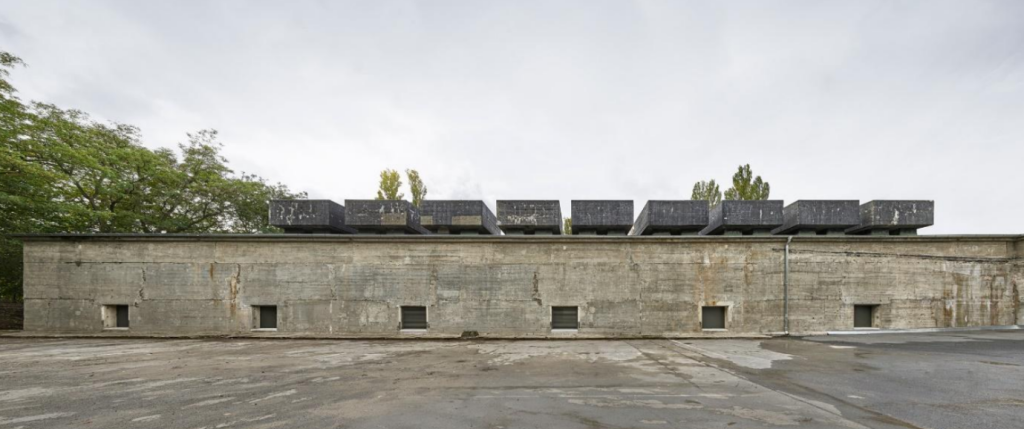
A museum experience
The Feuerle Collection, Berlin
The Feuerle Collection is a young museum in Berlin, founded in 2016 by Désiré Feuerle and Sara Puig, both well-known in the gallery world. It houses not only exquisite early stone and lacquer furniture, from the Han to the early Qing dynasties, from 200 BC to the 17th century, but also early Khmer sculptures from the 7th to the 13th century. In addition, a handful of international contemporary art by Zeng Fanzhi, Nobuyoshi Araki, Anish Kapoor, Cristina Iglesias, and Adam Fuss can be admired.
The building itself is impressive and even oppressive: a former telecommunications bunker from World War II. The bunker has been radically renovated in a minimalist style by British architect John Pawson (born 1949). Everything has been stripped down to the bare bones. Only the concrete remains. The decor gives the encounter between East and West a menacing charge.
This museum is a Gesamtkunstwerk . That's what they call it themselves, and they're right. The term refers to Wagner, who saw opera as a total work of art. Music and image, lighting and dance, text and song, set design and staging. You could see it as a precursor to film; all the elements must fit together perfectly to create a complete spectacle. You do have to adapt to the wishes of the organizers.
Access
You can't just walk into The Feuerle Collection. You have to book online, although you can also do so with your smartphone at the entrance to the bunker. A limited number of visitors are allowed at any given time, and you must follow a strictly defined itinerary. This is clearly explained in English. For example, you'll learn that the artworks are not labeled with information about the time, location, and creator, so as not to distract from the work itself.
You begin your visit completely immersed in darkness, with a mandatory "ritual": sitting for two minutes in the sound chamber, while an abstract fragment of a piano piece by John Cage (1912–1992) plays. A bit creepy, my companions found, but it's a thoughtful way to temporarily switch off the internal screens you unconsciously carry around. It invites you into a meditative state of being. At the same time, your retinas are given time to adjust to the darkness.
Then the guide signals to proceed, towards a point of light that only becomes visible after you have taken a few steps into the darkness. The transition from silence to movement, from darkness to light, feels almost ceremonial. The floor, ceiling, and walls are matte black, making you seem to lose all sense of direction for a moment. It creates a rare sense of seclusion.
The bunker itself is immense, and this only becomes truly apparent when you arrive at an unexpected feature: a "lake" behind glass. The water's surface is barely illuminated, but just enough to make it shimmer in the darkness. It seems to float in space—a still, reflective surface that enhances the meditative atmosphere. Peace and contemplation.
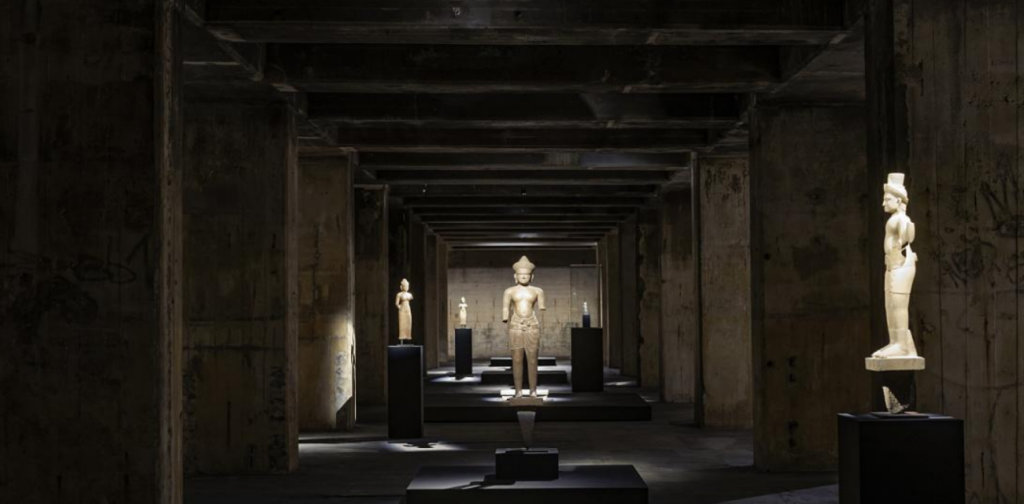
Image source: erco.com
Khmer
All the light falls on the perhaps twenty or thirty Khmer sculptures , named after an early medieval civilization in Cambodia. Sometimes there are clear references to Hinduism , while other statues bear Buddhist motifs. Yet I find myself starting to classify again—a reflex of my Western gaze. It's better to let go of that for a moment.
In the breathtaking encounter with these statues, in a dark room of a disused war bunker, what remains is the unmistakable sensuality that this sculpture exudes. The overall impression, but also every detail of the statues themselves, is superbly lit with ingenious spotlights, casting beautiful shadows on the floor.
Chinese furniture
The room we enter next – filled with Chinese furniture – is also cleverly lit. The atmosphere is cool here, and sensuality has given way to something that feels very concrete and real, yet also cold and reasonable. These are aspects of the East that we often overlook.
And… that's it. Two dark rooms in an old bunker. Nothing more. Minimalist, as we mentioned. I found it incredibly beautiful and even moving. On the way out, I spoke with a woman who wanted to go in a second time after I'd expressed my emotion about the experience in just a few words. She absolutely wanted to do it again.
There's also a separate incense room in the bunker, where a performance based on a Chinese tradition dating back over 2,000 years is performed. This can be booked separately, so I can't speak from experience.
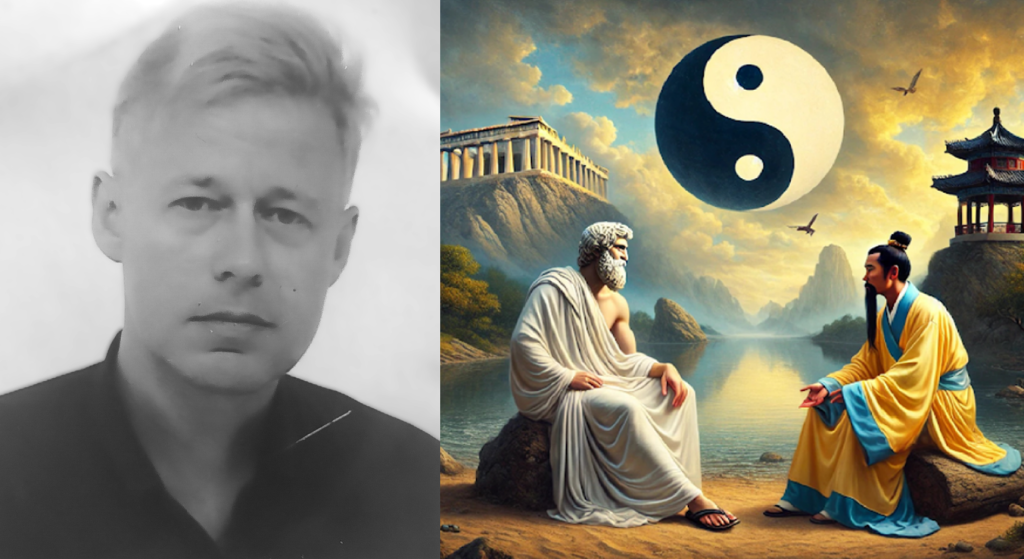
Photo: Olivier Lichtenberg and a piece from the cover of Fall or Rebirth of The West.
West and East meet
What remains is a stunning reminder of a singular conversation between diverse eras and cultures, and also a new perception of how to present ancient Eastern art in a Western historical setting that is itself particularly charged with meaning, as it monumentally recalls a war and an infamous regime.
I'd like to take this opportunity to point out that our celebrated guest author, Olivier Lichtenberg, takes strong positions on the relationship between the West and the East, and vice versa. He has just submitted an essay that we will be publishing. With my prior knowledge, I can already say that it challenges me to understand this contradiction and that I will share my opinion on it.
In the meantime, I invite everyone to discover the intellectual world of this intriguing author for themselves in his dedicated section on our website. His insights aren't always pleasant and are often confronting, but they do encourage reflection—for example, on our relationship with a country like China, which benefits from the West's inability to transcend internal divisions and collectively build a just society. You'll read more about this soon.

